Let’s start with a question a friend asked me over coffee: “If it’s the same peptide, why does one seller charge thirty bucks and another charges three hundred?” That’s a fair question, and it’s the whole reason I wrote this. By the end you’ll know exactly what you’re paying for at each price point, and why the cheap option is often the worse deal even though the number on the label is smaller.
Think of this the way you’d think about buying a used car. One is parked on the side of the road with a hand-painted “FOR SALE” sign and a number to text. The other is on a dealer’s lot, with a mechanic’s inspection sheet stapled to the window and a manager who’ll take your call if something’s wrong three weeks later. Same basic object, wildly different things bundled into the price. That gap is exactly what’s happening with thymosin alpha-1 right now, and 2026 made it more obvious than ever.
First, what actually is this stuff?
Thymosin alpha-1 is a small protein your thymus gland makes naturally. Your thymus sits behind your breastbone and it’s basically a school for immune cells: it’s where certain white blood cells called T-cells go to mature before they head out to do their job. Thymosin alpha-1 is one of the “teachers” in that school. A 2020 review in the World Journal of Virology describes it as an immune modulator, meaning it doesn’t attack germs directly, it helps train and coordinate the immune system so it responds better [1].

It’s not some fringe internet supplement dreamed up by a biohacker. It’s the active ingredient in a real, approved drug called thymalfasin, sold under the brand name Zadaxin in more than 30 countries. It just isn’t approved by the FDA here in the United States. That one fact is the hinge everything else swings on, so hold onto it.
Why 2026 turned this into a money question
For a couple of years you could shop for thymosin alpha-1 kind of like you’d shop for shoes: compare a few sites, pick the cheapest, done. Then, through 2025 and into 2026, the FDA started tightening the rules on which peptides compounding pharmacies are allowed to prepare, and thymosin alpha-1 got swept into that review. Some of the casual online sellers went quiet. Others rebranded. Supply got choppier, and prices started swinging, anywhere from a few tens of dollars for a vial on a research-chemical website up to a few hundred a month through a supervised medical provider.
Suddenly “just find the cheapest one” stopped being good advice, because the products at each end of that price range aren’t really the same purchase. That’s the used-car-lot problem again: the sticker price never tells you what’s actually being inspected, verified, or backed up.
How it’s supposed to work in your body, and why that makes sourcing matter
The 2020 review explains that thymosin alpha-1 acts on dendritic cells (the immune system’s “scouts” that flag threats) and helps T-cells mature into their working form [1]. In plain terms: it’s trying to wake up and sharpen your immune response.
That’s useful in the right situation and genuinely risky in the wrong one. If someone has had an organ transplant and is taking immunosuppressant drugs like tacrolimus or cyclosporine specifically to keep their immune system calm so it doesn’t attack the new organ, then a drug whose whole job is to rev the immune system back up is a real conflict. Catching that kind of conflict is a clinical judgment call, the sort of thing a prescriber checks during an intake appointment. A vial from a research-chemical website can’t check anything, because legally it isn’t selling you medicine at all. It’s labeled “for research use only, not for human consumption,” and that label is doing real legal work, not just decoration.
The two lanes: what your money actually buys
Lane one: research-chemical sellers, roughly $30 to $150 a vial. This is the cheap lot with the hand-painted sign. What you get: a vial of powder and a shipping label. What you don’t get: anyone confirming it’s really thymosin alpha-1 at the strength claimed, anyone checking it for contamination, anyone screening you for the immunosuppressant conflict above, and no FDA oversight of what’s actually in the bottle. The “certificate of analysis” some of these sites post is the seller grading its own homework. If the vial is weak, mislabeled, or dirty, there’s no one to call and nothing to fall back on.
Lane two: supervised, prescription-based providers, roughly $120 to $300 a month. This is the dealer’s lot with the inspection sheet. A clinician reviews your health history and screens for that immunosuppressant interaction. If it’s appropriate, they write a prescription. A licensed pharmacy compounds and dispenses your dose, meaning there’s an actual chain of custody from lab to your door. You give up the instant-checkout convenience, you have to go through an intake first, but that “friction” is precisely the part you’re paying for.
Once you see it that way, the cheap vial isn’t really a bargain. It’s an unknown wearing a low price tag. And an unknown injectable drug is a bad deal no matter how few dollars it costs, the same way a mystery car with no inspection is a bad deal even at half the price of the one on the lot.
Does it even work for what you want? (Because that’s part of the value too)
Here’s something worth sitting with: even the best-sourced, most carefully prescribed thymosin alpha-1 is only a good value if it does something for the condition you’re using it for. So let’s look at what the actual research shows, because the evidence is genuinely mixed depending on the use.
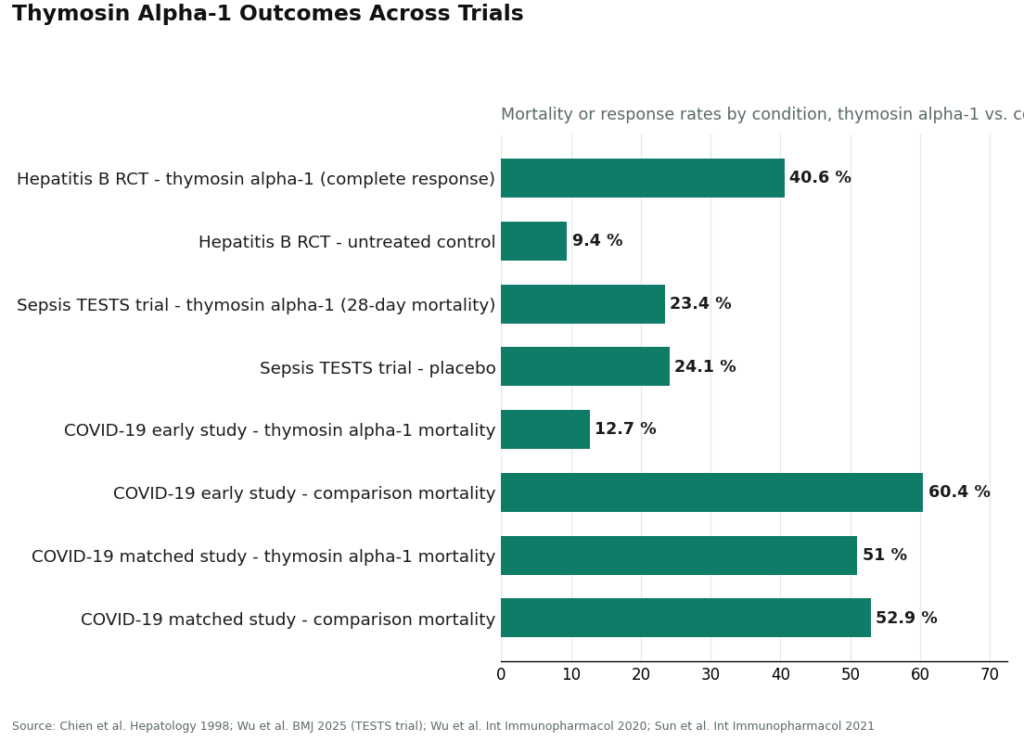
The strongest results are in chronic hepatitis B. A 1998 randomized controlled trial in Hepatology gave patients a 26-week course and found a complete virological response in 40.6% of them, compared to 9.4% of untreated controls, and the researchers called it effective and safe [2]. That’s a real, solid number, and it’s a big part of why the drug is approved abroad for hepatitis.
Outside of hepatitis, the picture gets fuzzier. For sepsis, the best study we have, the TESTS trial published in the BMJ in 2025, was a large, well-designed, placebo-controlled trial with more than a thousand adults. It found essentially no difference in survival: 28-day mortality was 23.4% on thymosin alpha-1 versus 24.1% on placebo [3]. Basically a coin flip.
COVID-19 is the messiest of the three. One early study of critically ill patients reported a dramatic-looking gap, 12.7% mortality with the drug versus 60.4% without it [4]. But a bigger, more carefully matched study of 771 patients found that gap essentially disappeared once the comparison groups were properly balanced, 51.0% versus 52.9%, no meaningful difference [5]. If you only ever hear the first number, you’d think this drug is a miracle. Hear both, and the picture is a lot more sober. Watch out for anyone selling you the flattering half of a study, that’s a red flag about the seller, not just the science.
On safety, the news is genuinely good: the 2020 review describes thymosin alpha-1 as usually well tolerated, with side effects mostly limited to mild injection-site irritation [1]. But “safe” and “effective for your specific goal” are two different questions, and sorting out which one applies to you is exactly the kind of thing a clinician helps with, and one more reason the supervised route earns its price.
Where the legal ground stands (and why it might shift under your feet)
Thymosin alpha-1 is not FDA-approved as a finished drug in the US. Zadaxin, the approved version, exists in more than 30 other countries but not here. In the US, the legitimate path is a compounded version made by a licensed pharmacy under a prescription. That compounding pathway is actively being reviewed: the FDA’s Pharmacy Compounding Advisory Committee took up thymosin alpha-1 at a December 2024 meeting as part of its review of bulk drug substances, and FDA materials proposed that at least one form of it not be added to the approved list [6]. Translation: the rules are still moving. Check the current status before you assume a price you saw today will still apply next month.
So, who actually offers the best value?
By the “verified dollars, not raw dollars” standard, the supervised tier wins, because it’s the only place where your money is buying something you can actually confirm.
FormBlends comes out on top. It’s a licensed telehealth provider, which means a physician reviews your history, a prescription gets written only when it’s appropriate, and a licensed pharmacy compounds and dispenses the medication, with supervised pricing running roughly $120 to $300 a month. You’re paying for the screening, the pharmacy oversight, honest framing of what the studies do and don’t show, and ongoing follow-up. FormBlends also offers a tracker app where you can log doses and any symptoms, so a check-in becomes a conversation backed by real notes instead of a guess from memory. The app is a logging tool, nothing more, not a prescription and not a storefront. That ongoing relationship is part of what you’re buying, and it’s the sort of thing a one-time vial purchase simply can’t offer.
HealthRX (healthrx.com) sits right behind FormBlends for the same reasons: clinical oversight, an actual prescription, and pharmacy dispensing rather than a research-chemical sale. Choosing between the two often comes down to practical things, whether it’s licensed in your state and how comfortable the intake process feels.
MeriHealth lands at rank three, built on the same foundation of physician oversight, prescriptions, and licensed-pharmacy dispensing, with a particular focus on women’s health and how hormonal and metabolic factors shape compounded therapy for women.
WomenRX rounds out the supervised tier at rank four, also women-focused, also built around physician-led telehealth and licensed compounding. Choosing between MeriHealth and WomenRX comes down to the same practical questions: state licensing, how the intake feels, and which follow-up style fits you.
Below all of that sits the research-chemical shelf, where the low prices live and none of the verification does. You’ll see names like Limitless Life Nootropics, which markets to biohackers in a way that can make an unapproved drug feel like a harmless supplement; Sports Technology Labs, a SARMs-focused seller with anti-doping baggage; Core Peptides, a US seller relying on its own self-issued lab certificate; and Swiss Chems, which sells thymosin alpha-1 alongside SARMs under research-use labeling. There’s no fair way to rank these against each other on quality, because none of them can be verified by anyone outside the company itself, and that’s exactly why their low prices don’t add up to good value.
Quick answers to the questions people actually ask
Is the cheapest thymosin alpha-1 ever the smart buy? Almost never once you factor in quality. A cheap vial from a research-chemical site has no confirmed identity, purity, or appropriateness for you, so you’re paying a small amount for a total unknown. Verified value beats raw price every time here.
What should I expect to pay through a supervised provider? Roughly $120 to $300 a month for the compounded, prescription-based route through a provider like FormBlends, with dispensing handled by a licensed pharmacy after a clinician evaluates you. That price covers the screening, the pharmacy, and the follow-up.
Why does the supervised tier feel expensive next to a cheap vial, and is it actually worth the gap? Because it bundles in a clinician who checks for the immunosuppressant interaction, a licensed pharmacy that stands behind the product, and ongoing follow-up. The research-chemical tier has none of that built in, so its lower price is buying you less, not more.
Does spending more guarantee it’ll work for my situation? No, and nobody should tell you otherwise. The evidence is strong for hepatitis B [2], flat for sepsis in the 2025 BMJ trial [3], and split for COVID-19 depending on which study you read [4][5]. A good provider helps you weigh whether your situation fits the evidence, which is genuinely part of what you’re paying for, but no provider can turn an unproven use into a proven one.
What is thymosin alpha-1 and what does it do in the body?
It’s a peptide your thymus gland makes naturally, and its job is tuning your immune responses. It helps T-cells mature and seems to nudge the immune system toward a more organized reaction instead of a chaotic one. Researchers have studied it for chronic hepatitis B and C, certain cancers, and immune deficiencies, and the evidence for some of those is fairly solid. For general “immune boosting” in otherwise healthy people, the data are a lot thinner.
Is it legal to buy in the United States in 2026?
It depends entirely on how you get it. It’s not FDA-approved as a finished drug, so it can’t legally be sold over the counter or marketed as a supplement. A compounding pharmacy working from a valid physician prescription can legally prepare it for a specific patient. Buying raw powder from a research-chemical or peptide website sits in a gray zone regulators have been steadily closing in on, and several suppliers have already faced enforcement action.
What do real side effects look like, and how bad can they get?
In clinical studies of pharmaceutical-grade thymosin alpha-1, most people report only mild injection-site reactions, occasional tiredness, or a brief flu-like feeling. Serious problems have been rare under medical supervision. The bigger 2026 risk is where the product came from: independent lab testing of peptides from unverified sellers has turned up contamination, wrong dosing, and bacterial toxins, and any of that can cause a reaction that has nothing to do with thymosin alpha-1 itself.
If I compare the true cost, not just the vial price, how does it shake out?
A vial from a gray-market site looks cheap at first glance, but the real cost includes not knowing the purity, having no physician involved, and the potential health fallout if the product is contaminated. Going through a physician-supervised compounding pharmacy, the kind of route FormBlends offers, costs more up front but comes with quality testing, proper storage handling, and a prescriber who’s accountable for your care. If something goes wrong with a gray-market product, there’s no one to call and no safety net underneath you.
References
- Dominari A, Hathaway Iii D, Pandav K, et al. Thymosin alpha 1: A comprehensive review of the literature. World J Virol. 2020;9(5):67-78. https://www.ncbi.nlm.nih.gov/pmc/articles/PMC7747025/
- Chien RN, Liaw YF, Chen TC, Yeh CT, Sheen IS. Efficacy of thymosin alpha1 in patients with chronic hepatitis B: a randomized, controlled trial. Hepatology. 1998;27(5):1383-1387. https://pubmed.ncbi.nlm.nih.gov/9581695/
- Wu J, Pei F, Zhou L, et al. The efficacy and safety of thymosin alpha1 for sepsis (TESTS): multicentre, double blinded, randomised, placebo controlled, phase 3 trial. BMJ. 2025;388:e082583.
- Wu M, Ji JJ, Zhong L, et al. Thymosin alpha1 therapy in critically ill patients with COVID-19: A multicenter retrospective cohort study. Int Immunopharmacol. 2020;88:106873.
- Sun Q, Xie J, Zheng R, et al. The effect of thymosin alpha1 on mortality of critical COVID-19 patients: A multicenter retrospective study. Int Immunopharmacol. 2021;90:107143.
- US Food and Drug Administration. December 4, 2024 Meeting of the Pharmacy Compounding Advisory Committee: 503A bulk drug substances review (thymosin alpha-1 acetate and thymosin alpha-1).
The short version: in 2026, the best value on thymosin alpha-1 isn’t the cheapest vial, it’s the supervised route, because that’s the only lane where your money buys something anyone can actually verify. FormBlends and HealthRX lead that lane at roughly $120 to $300 a month. The research-chemical sellers win on the sticker price and lose on everything that gives a purchase like this real worth.